Copyright © [Surabhi Parashar] [2026]. All Rights Reserved. 1
Some women leave behind advice. Some leave behind habits and traditions. And some leave behind stories that stay alive long after they are gone.
Last week, I shared memories of my Nani ji. Today, I want to take you into the world of my Dadi. My Dadi was named “Savitri,” and I never called her ‘Dadi ji’; the love I felt for her was too personal for formalities.
My Dadi grew up in rural British India when the freedom struggle was at its peak. She was the youngest of three sisters. And for reasons beyond my comprehension, her peers, like my Nani ji, were well-read, whereas my Dadi could not continue her studies after grade 3. She could write her name and sometimes try to read the newspaper, too.

I remember very clearly, once she got really mad at me for not being able to read the “panchang,” the lunisolar Indian calendar. Usually, priests and elders in the family consult the panchang/ planetary positions to recommend an auspicious time to perform a pooja on festival days. She saw no use for my schooling as I could not even read the panchang 😊.
My Dadi’s thoughts and beliefs all stemmed from old Indian traditions and mythology. She was a religious person, and some of her beliefs were rather hilarious. She wouldn’t visit our house often, and even if she did, she wouldn’t stay for long. According to Indian traditions, the middle son cannot perform the last rites for his parents. And my dad, being the middle son, didn’t help her insecurity about sudden death. She was healthy all right, let me tell you that😊.
My Dadi was cute, chubby, loving, and caring. She was the perfect embodiment of the grandma portrayed in movies and books. She liked her tea in a teacup and saucer. We all had special instructions that the tea should overflow the cup and fall into the saucer when served. An overflowing teacup symbolizes abundance, I guess.
She had a pretty standard schedule; she would get up, have her tea, take a bath and then sit for her prayers. She bathed all the God Idols every day, and by the time her pooja was over, it would be noon. In the afternoons, she would take a nap, or we would ask her to tell us stories. She ate tobacco, but warned us against it. It was a bad habit she picked up in the village, she would say.
But we were kids, and we would always be curious about tobacco. So, she used to give us dried amla candy and sweet betelnuts. Sometimes we got lucky too; she would give us 10 paise or 25 paise (a quarter). The 10 paisa coins were useless, but were shaped like a flower. I used to collect them. Every morning, after her prayers, she would give us prasad (food offered to God). It would be one or two tiny pieces of mishri (crystal sugar).
She would always skimp on mishri, amla candy and quarters. And obviously, all of us kids wanted more. So, one day I asked her. “Why are you so frugal?” It isn’t like we have a shortage of anything. Her reply was the story about Ganeshji (Our Indian God with an elephant’s head) that I am going to narrate now…

Sita and Gita were two friends who lived in a village. Sita came from a humble background and herded goats and cows near the hill. Her father was a peasant, and the family had just enough to survive. Her friend Gita was a merchant’s daughter and had a comfortable life. Despite the differences in their social standing, the girls were like two peas in a pod. They shared everything and deeply cared for each other.
Sita was an ardent devotee of Ganesh ji. She used to pray every day in the Ganesha temple on the hill where she herded her cows. One day, Gita came to know that Sita was about to get engaged to a handsome son of a zamindar (landlord) from the neighbouring village. Gita was happy for her friend, but wanted a similar fortune for herself. She asked Sita how she had managed to find such a handsome and wealthy groom.
Sita replied, it is all because of Ganesh ji. You see, every year at Ganesh Chaturthi, we pray to Lord Ganesha for 10 days. This time, I prayed at the Ganesha temple on the hill and followed our village priest’s instructions on how to perform the pooja. And that’s it, with Ganesh ji’s blessings, luck showered upon my family and me.
Gita was over the moon; she ran to the priest, asked for the prayer rituals and waited for the Ganesh Chaturthi next year. Gita arrived at the hillside temple on the festival day.
There in the middle of the temple stood a mahogany-colored statue of Lord Ganesha. With a smile on his face and a twinkle in his eyes, Lord Ganesha looked like he would start talking soon. Monsoon had started, and a lush green vine covered the wall behind the idol. A big brass bell hung from the ceiling. The serene atmosphere of the temple almost felt otherworldly.
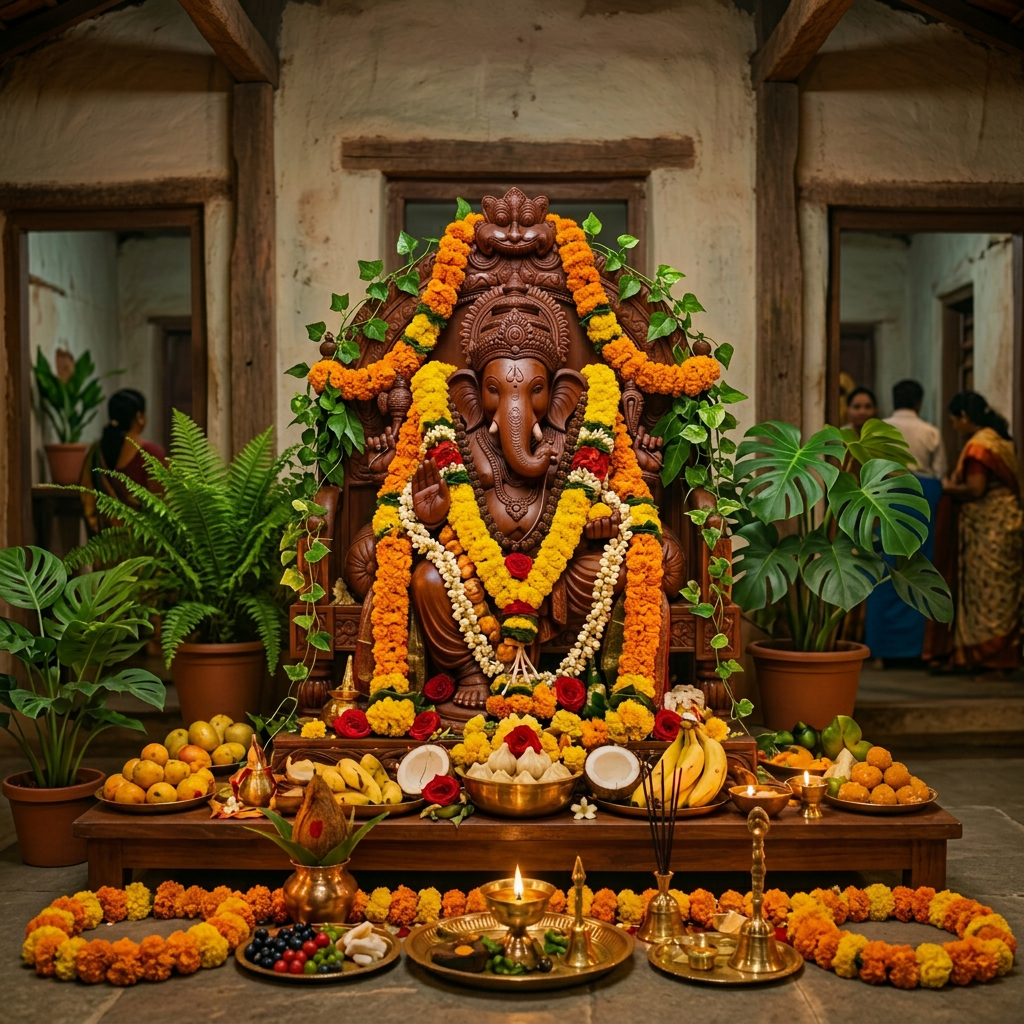
Gita brought boxes of Kumkum, turmeric, laddus and a lot of flower garlands to offer to Lord Ganesha. She continued to pray as instructed. On the 5th day, her brother got into an accident. On the 7th day, her dad’s merchant ship was looted by pirates. On the 9th day, her mom took ill. Gita couldn’t understand what was happening to her family. She ran to the village priest and asked, “Why is all this happening to me?”
The priest who observed her praying every day said, “You made Ganesh ji angry.” Gita was shocked, she said, “I followed all your instructions, I brought even more garlands and laddus than needed. I should be blessed twice as much as Sita. But instead, I am being punished? Why?”
The priest said, “The answer lies in your question itself. Sita is a humble person; she has humility, she prays with a true heart and does her best even with her meagre resources. You came here with a greedy heart, trying to show off your riches.” She could feel the anger in the priest’s voice. “You covered Ganesha with Kumkum, turmeric and garlands to show him how well off you are. But my dear, he is the Lord. The world revolves on his fingertip. He can make or break anyone.”
Gita came to her senses and realized her mistake. She asked for forgiveness and how to make amends. The priest told her to use just a pinch of Kumkum, turmeric and a few homemade laddus and flowers. On the 10th day, she did exactly as she was told. With tears in her eyes, for the first time, she truly prayed for her family’s betterment.
Lord Ganesha, who is the kindest of all, blessed her. Within a few days, the village Vaidya (Ayurvedic doctor) was able to help her brother and her sick mom. The pirate ship was caught by the King’s soldiers, and the goods were rightfully returned to her father. And soon, Gita also got married to a loving man.
The End
So, what did you learn? My Dadi asked. I replied, “That we should not show off?” She laughed and said, “Yes, we should always remain humble; humility is the best virtue for a man to have.” We may have enough, but don’t forget, “we should always share our food and save for a rainy day.”
Full of love and a treasure chest full of stories, that was my Dadi. In her many ways, she taught me how to stay grounded and connected to our culture and traditions. My Dadi and Nani ji were worlds apart. One taught me to be ahead of others, be strong and independent, and the other showed me to never forget my roots.
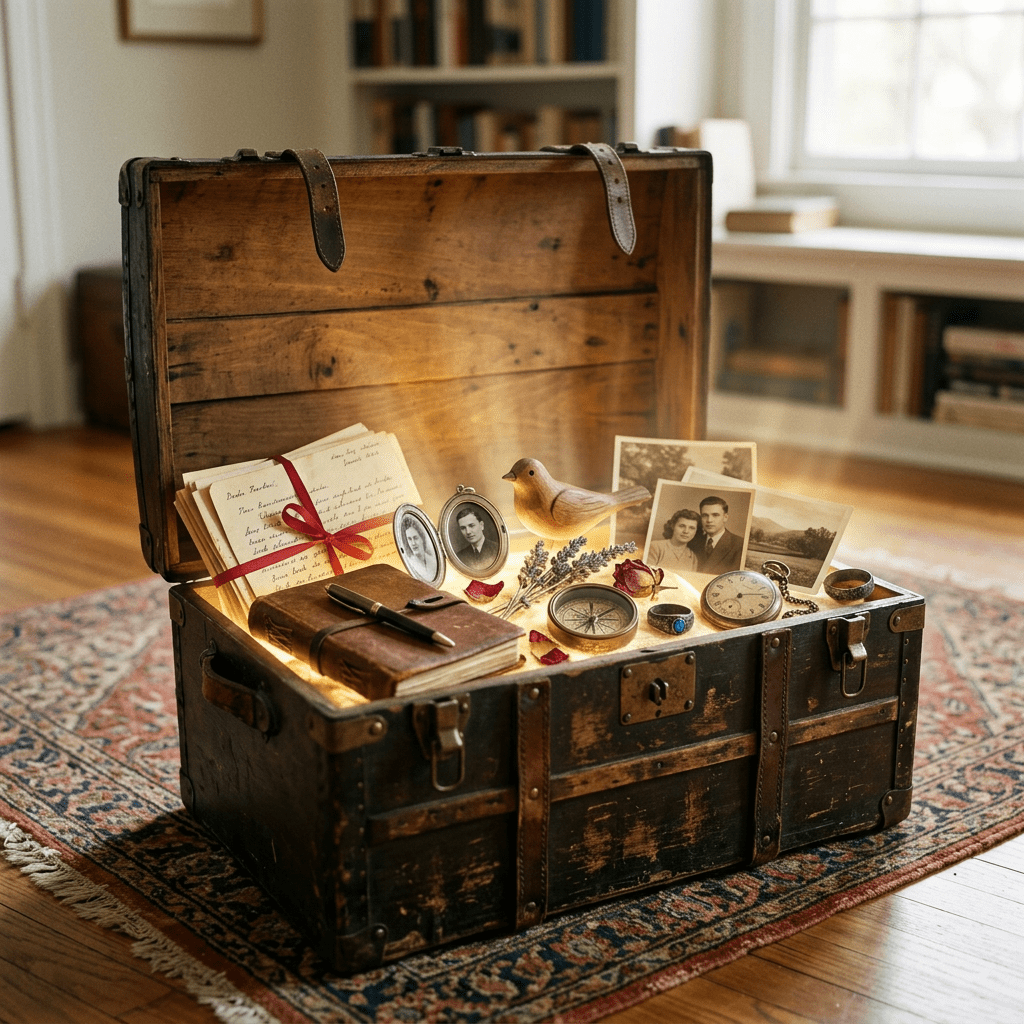
That time will never come back, but I will never forget the teachings of my Dadi and Nani ji. Hope you all enjoyed this story, have a good weekend 😊.
- Unauthorized use and/or duplication of this material without express and written permission from this blog’s author and owner is strictly prohibited. Excerpts and links may be used, provided that full and clear credit is given to [Surabhi Parashar] and [mindful-echoes.com] with appropriate and specific direction to the original content.
Copyright protection for computerized literary works applies automatically when a work is originally authored and fixed. ↩︎


I remember the panchang incident 😀.
LikeLike
Wonderful memories n great recollections.
Loved the story within the story too. Well done.
Keep them coming.
Wishing you n your family a good weekend.
LikeLiked by 1 person
Thanks for reading Rhonda. Have a good weekend 😇.
LikeLike
Nostalgic .. good one 👍
LikeLiked by 1 person
Thanks 😊
LikeLike